


Underwater pelletizing systems
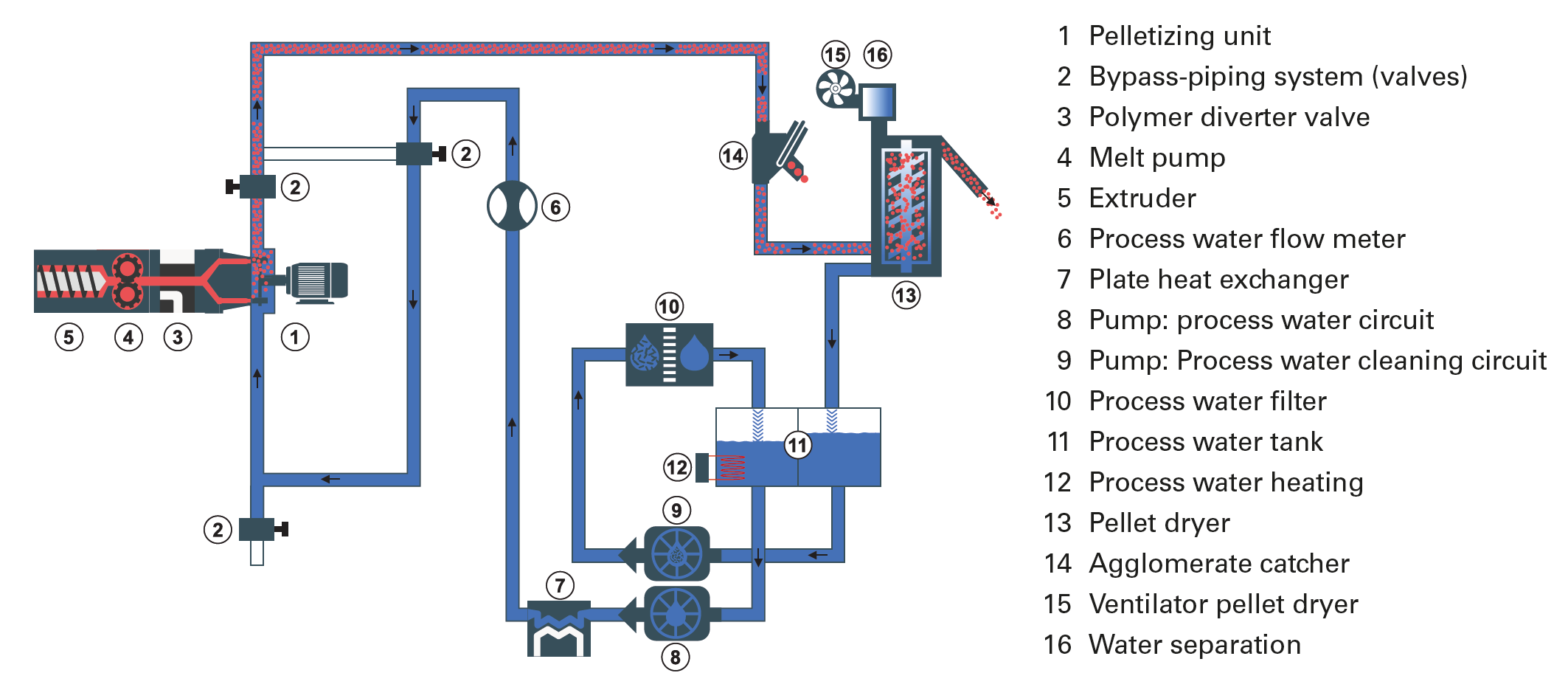
Underwater pelletizing
Underwater pelletizing is a continuous process for producing high-quality plastic pellets. The process is particularly suitable for thermoplastics, compounds, masterbatches, engineering plastics, and recycling materials. By cutting the polymer melt directly under water, uniform and spherical pellets with high bulk density and excellent flowability are produced.
Process description of underwater pelletizing
The polymer melt is continuously supplied by the extruder or another melt-feeding system and – if required – conveyed to the die plate via a melt pump and a start-up valve. Inside the die plate, the melt is distributed into the individual die holes and pressed through them into the cutting chamber.
The cutting chamber is continuously flooded with tempered process water. Directly in front of the die plate, a rotating knife head cuts the emerging polymer melt into pellets. Due to the surface tension of the polymer, nearly spherical pellets are formed.
The process water then transports the pellets through a piping system to the pellet dryer. Inside the dryer, the pellets are separated from the process water. The dried plastic pellets are subsequently transferred to downstream equipment such as classification systems, conveying units, bagging stations, or storage systems.
After the drying process, the process water is filtered, retempered, and pumped back to the cutting chamber by the process water pump. This creates a closed and efficient process water circulation system.
Advantages of underwater pelletizing system
- Production of uniform, spherical pellets
- High bulk density and excellent flowability
- Suitable for high throughput rates
- Continuous process operation
- High degree of automation
- Low dust generation
- Suitable for a wide range of thermoplastics and compounds
- Efficient process water circulation
Typical applications
Underwater pelletizing systems are commonly used for:
- Compounding
- Masterbatch production
- Engineering plastics
- Recycling processes
- Thermoplastic elastomers
- High-performance polymers
- Polymer and raw material production